How to Manage ADHD When a Diagnosis and Medication Aren't Enough
How to Manage ADHD When a Diagnosis and Medication Aren't Enough
You got the diagnosis. Maybe you even have the prescription. So why does life still feel like a never-ending game of catch-up?
If you're wondering how to manage ADHD when the basics are supposedly "handled," you're not alone, and you're not doing it wrong. In this post, I'll walk you through the difference between diagnosed and managed ADHD, the three parts of managing ADHD well, why all-or-nothing plans keep failing, and the self-care fundamentals that make everything else easier.
I'm Amy, a mom with ADHD raising kids with ADHD, and I learned all of this the hard way.
Diagnosed vs. Managed ADHD
I was diagnosed at five. I've been on medicine most of my life. And I still spent years yelling more than I wanted to, overdrinking, overeating, dropping balls everywhere, and riding the burnout rollercoaster.
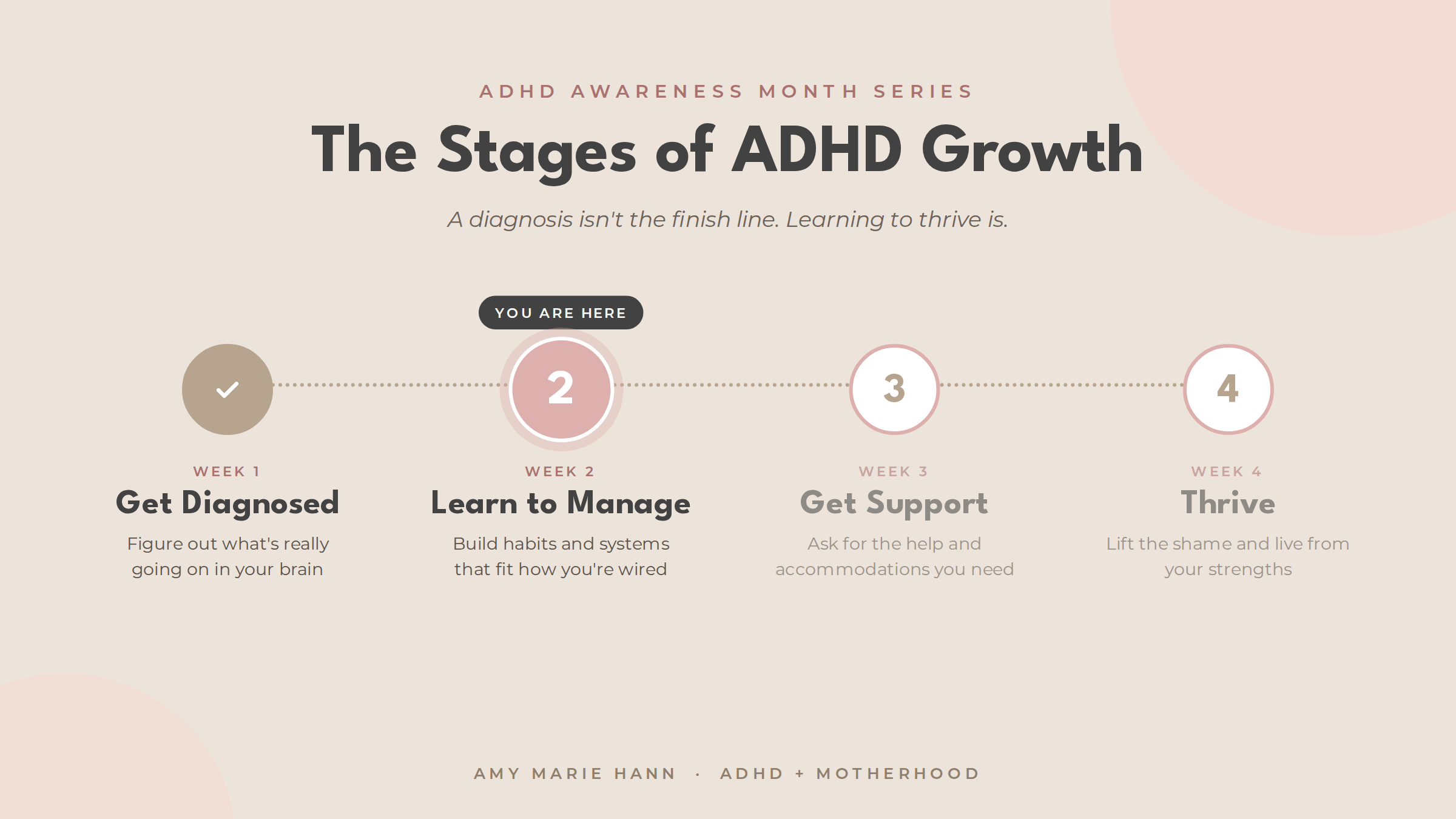
My ADHD was diagnosed. It was even treated. But it wasn't managed.
Most people talk about ADHD as diagnosed vs. undiagnosed. I think the line that matters more is managed vs. unmanaged. You can have a diagnosis and a prescription and still not have the support you need.
The Three Parts of Managing ADHD
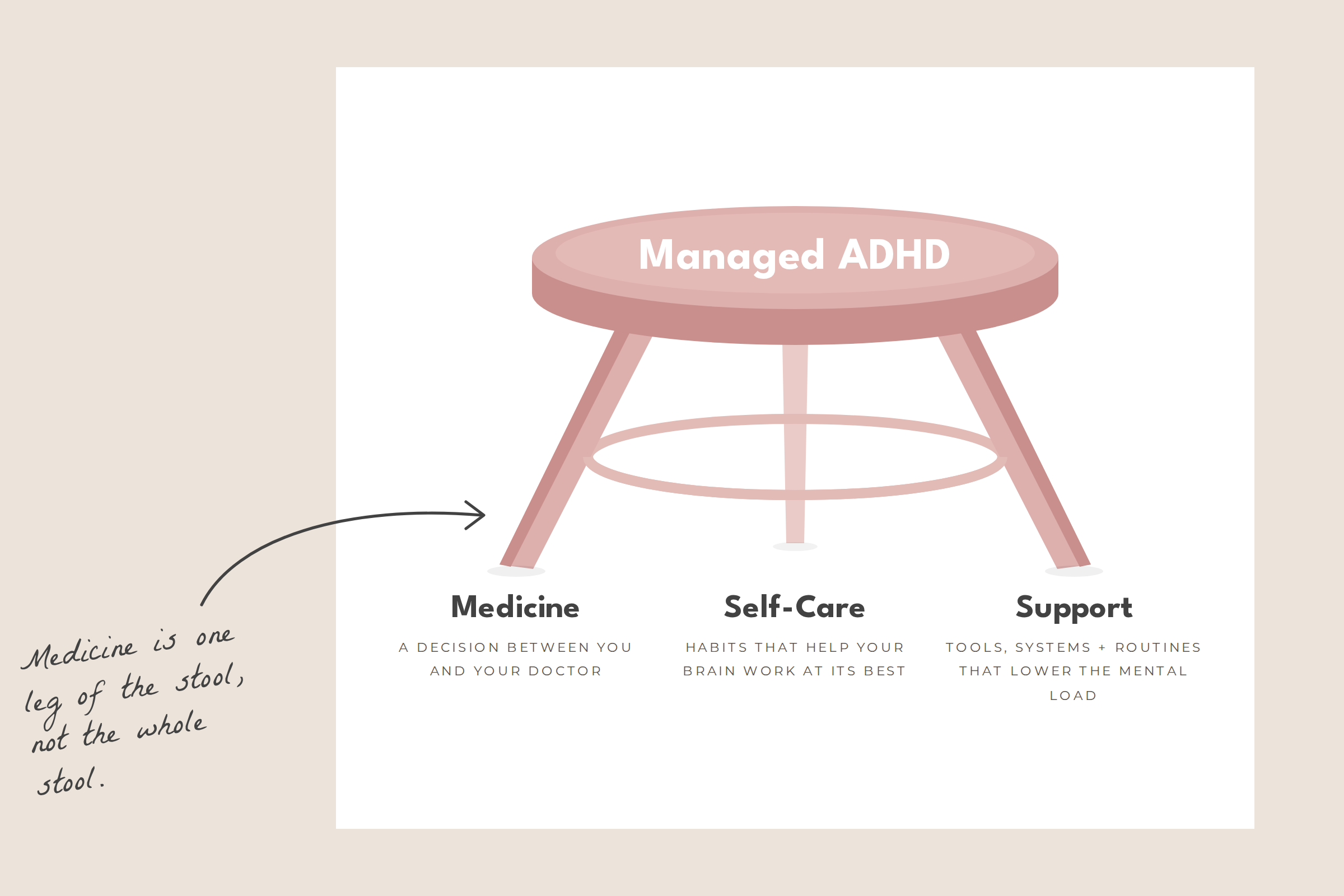
Managing ADHD well has three prongs, and this part isn't just my opinion. It's what the research consistently points to:
- Medicine. Most people with ADHD (roughly 70 to 80 percent) respond well to medication. That's a decision between you and your doctor, and this is a zero-shame medicine zone. I've been medicated most of my life, and so has everyone else in my house. But medicine is one piece of the puzzle, not the whole puzzle.
- Self-care. Personal habits that help your brain work at its best, lower your stress, and regulate your emotions.
- Support. Tools, systems, and routines that lower your ongoing mental load so life is less taxing.
I'm not a doctor, so I can't help you with the medicine piece. But self-care and support are where I've spent fifteen years of trial and error. And even if you're still sitting on a waitlist for your evaluation, you can start on these two today. (If you're still at that stage, start with how to pursue an ADHD diagnosis.)
Why Managing ADHD Feels Like a Full-Time Job
Once I saw that so many of my daily motherhood struggles were really ADHD struggles, it was clear I had to start giving my brain what it needs. How could I expect my brain to behave differently if I wasn't giving it what it needs to function?
And that revelation was so annoying. Managing my own mental health kind of felt like a full-time job. I wanted an easier, quicker fix I could start that afternoon.
But I was desperate enough to go all in, and it paid off big time. I don't just mean my house got cleaner or I yelled less at the kids (though that happened too). I launched the business I'd dreamed about and 10xed my income while working less. I finally kicked the overdrinking and overeating that plagued me for years. My home got calm on a (mostly) daily basis. And my marriage is stronger than it's ever been.
Why All-or-Nothing Plans Don't Work for ADHD Brains
For years, every time I tried to get my life together, I made the same enormous mistake. It sounded something like this:
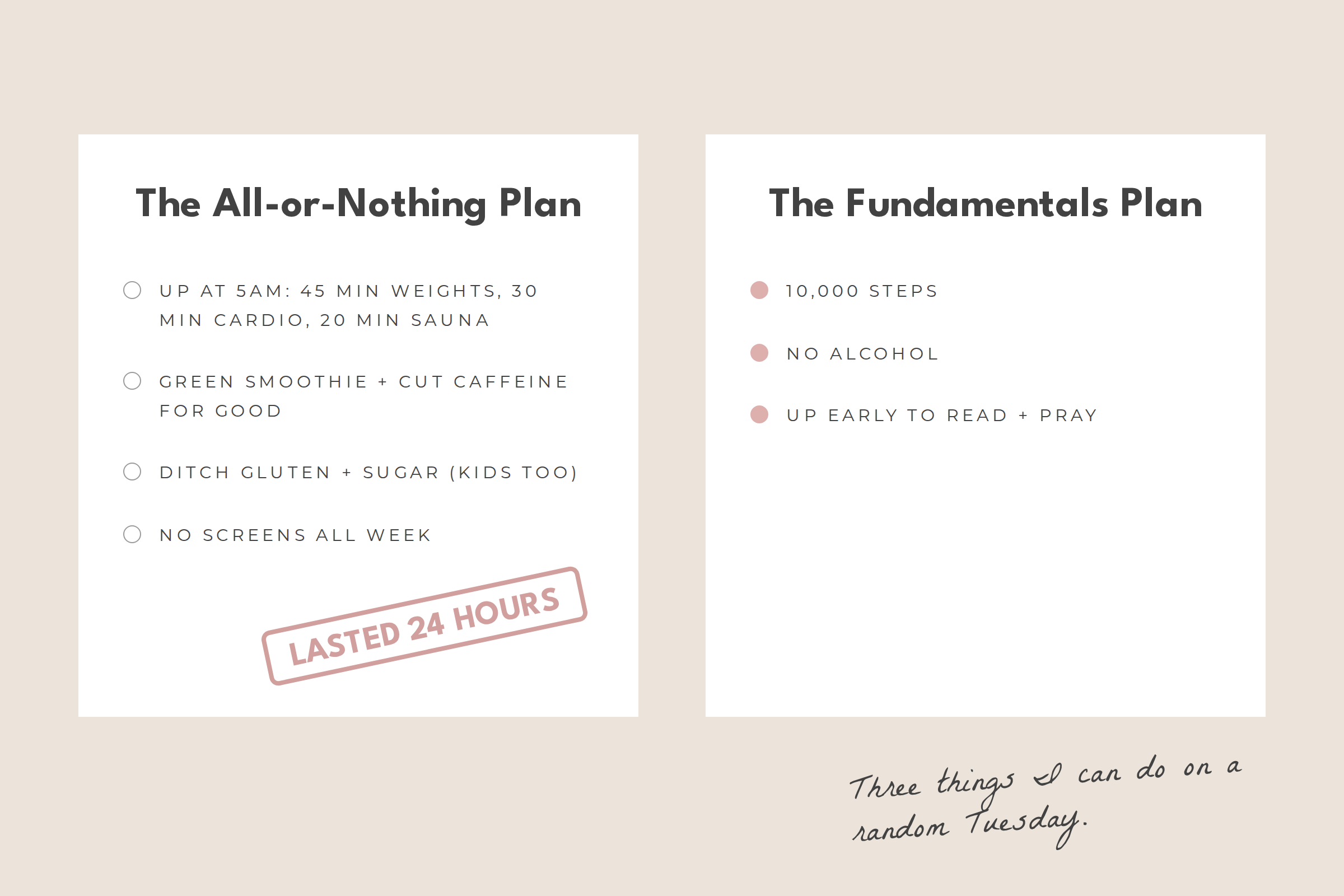
- I'm going to start waking up at 5am to go to the gym for 45 minutes of weights, 30 minutes of cardio, and 20 minutes in the sauna.
- Then I'll come home and make a green smoothie, because I'm cutting out caffeine for good.
- I'm finally ditching gluten and sugar and getting the kids off their mac and cheese addiction.
- And no more screens during the week, because I'm sick and tired of the cranky attitudes.
These plans rarely survived 24 hours. Because I, despite my own desires, am not in fact a robot. I can't reprogram every one of my settings on a random Tuesday night.
None of those changes are bad. But nobody can change all of them at once, and trying to will leave you feeling like a failure. All-or-nothing thinking is one of the biggest traps for ADHD brains.
Then there's Instagram. Red light masks. Weighted vests. Cold plunges. I love a new gadget as much as the next gal, but I didn't need a longer list of things to do. I needed clarity on what mattered most and permission to focus on fewer things.
What I Learned From Parenting Books About Managing My Own ADHD
The breakthrough came from a strange place: my stack of ADHD parenting books.
I was reading books on home management, books on managing my ADHD, and books on parenting my kids. Each one came with its own list of things I should be doing, and every list pulled from the same tank. I just kept getting more depleted.
But the parenting books kept coming back to the same few principles. And one day I thought: what if I did that for myself? Here's what parenting myself looks like:
- Focus on the fundamentals. Not every hack. Just the basics that make the biggest difference.
- Clear, specific, realistic expectations. If you give a kid with ADHD ten things to do in the morning, they'll do zero. Give them three, and the odds go way up. Same for us.
- One or two areas at a time. Dr. Ross Greene gives parents permission to put some struggles on the back burner and focus on one or two at a time. I gave myself the same permission.
- Praise and encouragement. This was the hardest one for me. Positive reinforcement is what actually creates change for ADHD brains. Beating ourselves up doesn't.
And here's the kicker. My kids hear how I talk to myself. I can't tell them to focus on one thing at a time and celebrate small wins while I beat myself up for everything I'm not doing.
The Self-Care Fundamentals for Managing ADHD
So where do you actually start? With the foundation of the foundation: the ADHD self-care basics of sleep, movement, nutrition, and emotional regulation.
I know. You've heard "sleep, exercise, eat well" a thousand times. But these aren't wellness extras for ADHD brains. When I'm short on sleep, skipping movement, or running on coffee and Goldfish crackers, my executive function tanks. I miss my meds, I struggle with the smallest tasks, and I'm way more reactive with my kids.
One of the moms in my Master the Mundane community put it perfectly:
"I sure notice when I am neglecting my self-care. I am less productive, miss taking my medication, eat poorly and struggle with the smallest of tasks. When I sleep, eat and take my meds correctly, I am usually more productive and feel like I can manage my day more efficiently and easily. I find more joy in my day and in others."
The four fundamentals:
- Sleep. It matters for everyone, but it's imperative for ADHD brains.
- Movement. Exercise boosts dopamine and norepinephrine, which makes executive function easier.
- Nutrition. Not a diet. Usually it starts with simply eating enough, consistently.
- Emotional regulation. Big feelings are a normal part of ADHD. The goal is a consistent way to release them before they turn into yelling or shame.
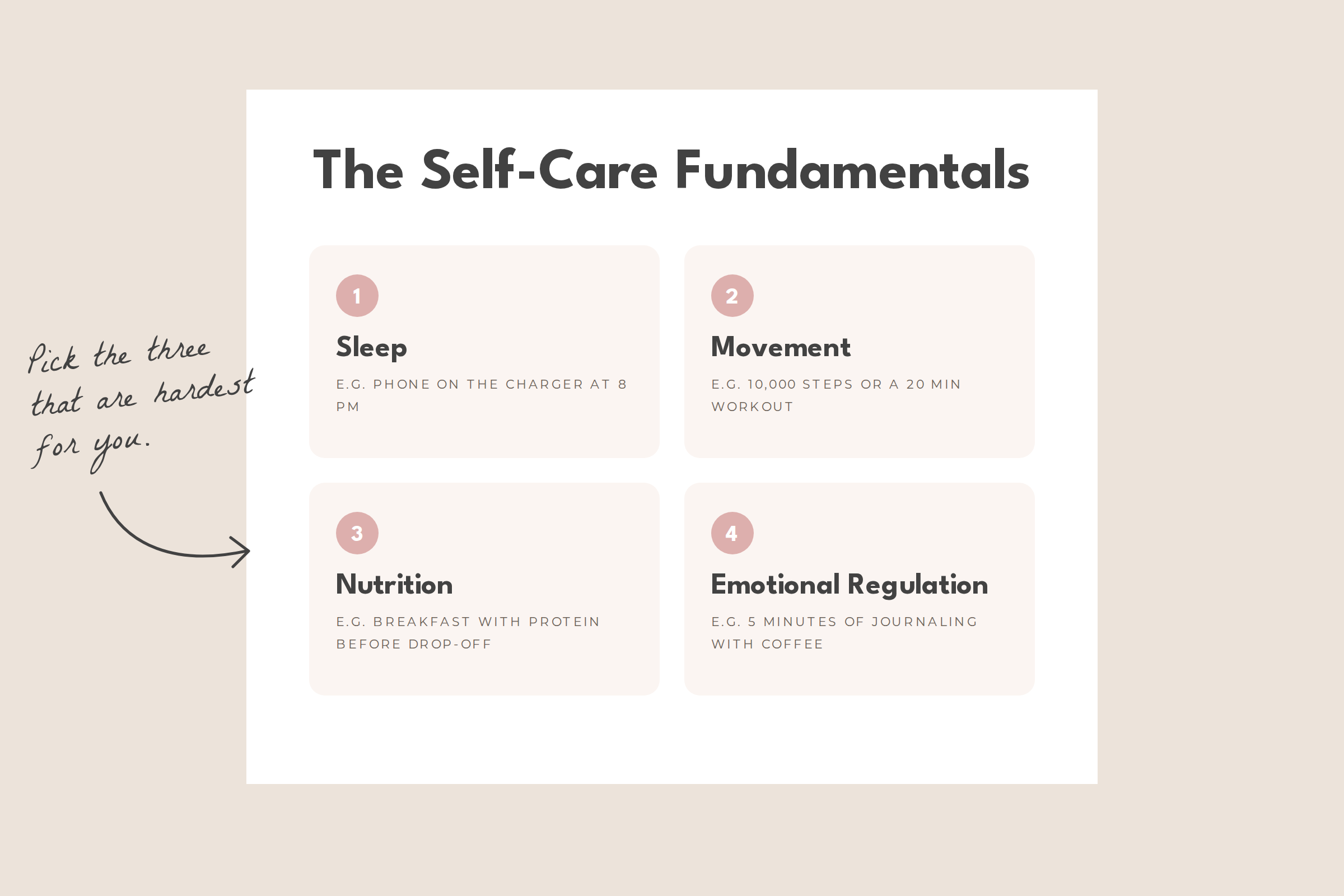
The trick isn't doing all four perfectly. It's picking a small number of specific habits you'll actually do on a random Tuesday when your kid has a fever and the dog threw up.
Managing ADHD Starts With Doing Less, Better
If you've been trying to fix everything at once, here's your permission to stop. Learning how to manage ADHD isn't about finding the perfect plan. It's about choosing a few fundamentals, making them specific enough that you don't have to think about them, and coming back to them again and again.
Diagnosed isn't the same thing as managed. But managed is absolutely possible.
Want the exact way I pick and stick to my habits? In the full version on my Substack, ADHD + Motherhood, I share the "EF budget" I use to avoid burnout, my sleep math formula, the movement shifts that finally made exercise stick, the nutrition change that stopped my evening binges, how I handle emotional regulation at 5pm, and two copy-and-paste AI prompts that help you choose your three habits and build a printable habit tracker.
[READ THE FULL VERSION ON SUBSTACK]